
India's Aviation Revolution The Rise of Bhogapuram International Airport and Its MRO Facility
- Jan 5
- 7 min read
Key Insights on Bhogapuram International Airport
Strategic Greenfield Project: The Alluri Sitarama Raju International Airport (ASRIA), formerly known as Bhogapuram International Airport, represents a transformative public-private partnership (PPP) initiative aimed at addressing capacity constraints at Visakhapatnam Airport and unlocking economic potential in Uttara Andhra, with Phase 1 investments totaling ₹4,592 crore (US$540 million).
Rapid Progress Toward Operations: Following a successful first validation flight on January 4, 2026, using an Air India Airbus A320, the airport is on track for commercial operations in May/June 2026, ahead of schedule, with 96% construction completion.
Integrated Aerospace Ecosystem: Beyond passenger traffic, ASRIA anchors a 500-acre aerospace park featuring the world's largest Maintenance, Repair, and Overhaul (MRO) facility, projected to generate thousands of high-skill jobs and position Andhra Pradesh as a global aviation hub.
Economic Multiplier Effects: The project is expected to catalyze tourism, industrial exports (e.g., shrimp, pharma), real estate development (including 20 planned Tata hotels), and job creation across sectors, potentially boosting regional GDP through enhanced multi-modal connectivity.
Investment Appeal: Backed by the National Investment and Infrastructure Fund (NIIF) with up to ₹6.75 billion, the initiative signals strong financial viability, though success hinges on sustained policy support and global aviation recovery.

Project Background
The existing Visakhapatnam Airport, operating as a civil enclave within a naval air station, faces severe limitations due to military priorities, including restricted slots amid the basing of INS Vikrant. This has constrained regional growth in tourism, industry, and exports. ASRIA emerges as a greenfield solution on 2,200 acres in Bhogapuram, Vizianagaram District, strategically located 44 km north of Visakhapatnam, serving a catchment area encompassing North Andhra and South Odisha.
Core Infrastructure and Design
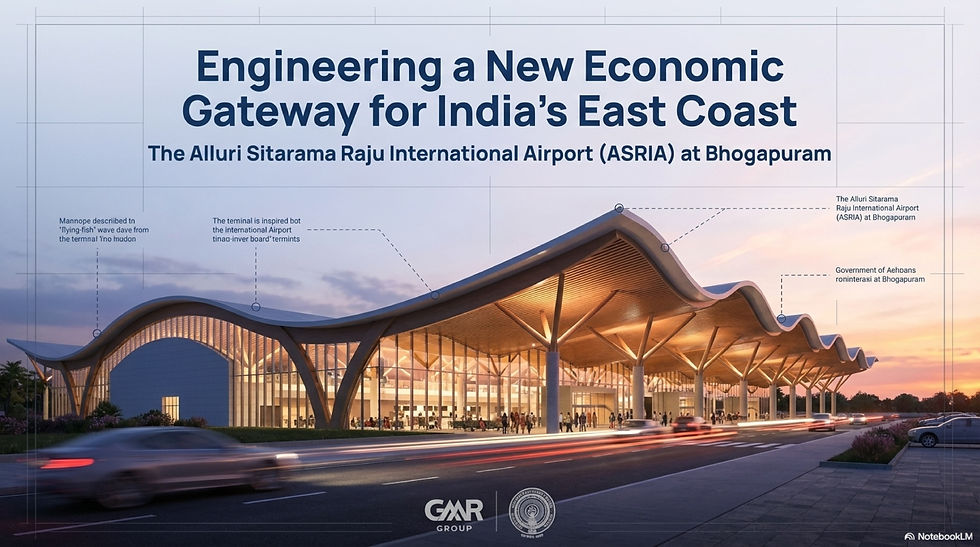
ASRIA's Phase 1 features a 3,800-meter runway capable of handling wide-body aircraft like the Airbus A380 and Boeing 747-8, with CAT-I Instrument Landing System (ILS) for all-weather operations. The terminal adopts an iconic "flying-fish" architectural motif, blending global technology (e.g., Digi Yatra facial recognition, 6-km automated baggage system) with cultural elements like a 120-meter digital heritage display and 90-foot Etikoppaka toy installation. Sustainability targets include LEED Gold certification, 5 MW solar power, and rainwater harvesting.
Business Model and Phasing
Developed by GMR Visakhapatnam International Airport Limited (GVIAL) under a 40-year PPP concession with the Andhra Pradesh Airports Development Corporation (APADC), the project unfolds in phases: Phase 1 (6 million passengers per annum, or MPPA), scaling to 18-24 MPPA ultimately. Initial capacity supports 2,500 passengers per hour, with over 10 aerobridges for efficient processing.
Projected Economic Outcomes
Research suggests ASRIA could create thousands of direct and indirect jobs, from construction to aerospace engineering, while spurring investments in IT, pharmaceuticals, and hospitality. As a cargo hub near Visakhapatnam and Gangavaram seaports, it will expedite high-value exports like seafood and horticulture to the US, EU, and Japan, reducing logistics costs. The adjacent GMR-Mansas Aviation EduCity (136 acres) aims to train global aviation talent, targeting 25% of the worldwide civil aviation workforce to be Telugu.

Comprehensive Analysis: ASRIA as a Catalyst for Regional Transformation
The Alluri Sitarama Raju International Airport (ASRIA) at Bhogapuram stands as a pivotal infrastructure endeavor in India's aviation landscape, engineered not merely as a passenger gateway but as the nucleus of an integrated aerospace and economic corridor along the eastern seaboard. This analysis, drawing from project documentation and recent developments, examines ASRIA's strategic rationale, operational blueprint, financial underpinnings, socioeconomic ripple effects, and prospective challenges. As of January 5, 2026—mere hours after the landmark first validation flight—it exemplifies how targeted public-private synergies can propel underdeveloped regions toward global competitiveness.
Historical Context and Strategic Imperative
India's aviation sector has witnessed exponential growth, with domestic passenger traffic surging 15-20% annually pre-pandemic and rebounding robustly thereafter. However, regional disparities persist, particularly in eastern India. Visakhapatnam International Airport, the primary hub for Andhra Pradesh's northern districts, operates under acute constraints as a civil enclave within the Indian Navy's INS Dega air station. Key bottlenecks include limited runway expansion potential, restricted international slots due to heightened military activity (e.g., INS Vikrant operations), and a cap on commercial flights that hampers global connectivity. These limitations have stifled Uttara Andhra's potential in tourism (coastal and eco-destinations), aquaculture exports, and emerging industries like IT and pharmaceuticals.
Conceived in 2015 with technical approval from the Airports Authority of India (AAI), ASRIA addresses this void through a greenfield model on 2,200 acres in Bhogapuram, Vizianagaram District. The site's proximity to National Highways 16 and 26 (44 km from Visakhapatnam, 23 km from Vizianagaram, 64 km from Srikakulam) positions it as a multi-modal logistics nexus, integrating air, sea (via nearby ports), and road networks. A proposed 6-lane coastal corridor will slash travel time from Visakhapatnam to 45 minutes, complemented by elevated roads, master plan corridors (26.72 km by VMRDA), and Phase 2 Visakhapatnam Metro extensions. This infrastructure triad not only mitigates congestion but amplifies ASRIA's role as an economic enabler.
The project's renaming in September 2024 after freedom fighter Alluri Sitarama Raju underscores its cultural resonance, aligning with Andhra Pradesh's vision for inclusive growth. Foundational milestones include the 2016 in-principle GoI approval, 2019 first foundation stone by N. Chandrababu Naidu, 2020 developer selection of GMR Group, and 2023 second stone-laying by Y.S. Jagan Mohan Reddy, with construction commencing November 1, 2023.
Project Architecture: From Gateway to Ecosystem Anchor
ASRIA transcends traditional airport paradigms, embodying a dual mandate: a state-of-the-art international terminal for 6 MPPA in Phase 1 (scaling to 18-24 MPPA across four phases) and the cornerstone of a 500-acre "plug-and-play" aerospace park. Developed by GVIAL—a GMR Group subsidiary—under a 40-year PPP with APADC, the initiative leverages GMR's proven track record (e.g., Hyderabad's Rajiv Gandhi International Airport, handling 25+ MPPA).
Phased Development and Capacity Ramp-Up
Phase | Passengers per Annum (MPPA) | Key Infrastructure Additions | Timeline |
Phase 1 | 6 | 62,500 m² terminal, 3,800 m runway (Code E/F capable), cargo terminal (5,000 m²), ATC tower | Completed Q2 2026 (ahead of 2025 target) |
Phase 2 | 12 | Terminal expansion, additional aerobridges | 2028-2030 |
Phase 3 | 18 | Enhanced cargo and MRO integration | 2032-2035 |
Phase 4 | 24 | Full ecosystem maturity, including EduCity linkages | 2035+ |
Phase 1 investment stands at ₹4,592 crore (US$540 million, or approximately Rs47.5 billion per some estimates), financed via equity, debt, and strategic infusions like NIIF's up to ₹6.75 billion commitment in December 2023. This funding underscores investor confidence in ASRIA's revenue streams: aeronautical fees (landing, parking), non-aeronautical (retail, F&B), and ancillary (MRO, cargo).
Airside infrastructure is robust: a 3,800 m x 45 m runway (10/28 orientation) with parallel taxiways, designed for 275 km/h wind resilience and full operability in 27 cm rainfall. It accommodates wide-bodies like A380s, verified by the January 4, 2026, Air India A320 validation flight (Flight AI 3198), which tested navigational aids and marked 96% construction progress. Landside features a "flying-fish" terminal with 20 m ceilings for natural light, paperless processing via Digi Yatra, and a 6 km automated baggage network handling 2,500 passengers/hour. Cultural infusions—120 m digital heritage walls and 90 ft Etikoppaka installations—enhance passenger experience while promoting Andhra's identity.
Unique to ASRIA is its aerospace ecosystem: a 500-acre park housing the world's largest MRO (25 acres initially, expandable) for airframes, engines, and components, alongside OEM manufacturing, R&D centers, and supply chain logistics. This "complete value chain" attracts global players (e.g., Boeing, Airbus suppliers), reducing India's foreign MRO dependence (currently 70% outsourced) and capturing a slice of the $80 billion global market. Adjacent is the 136-acre GMR-Mansas Aviation EduCity at Annavaram, India's first integrated aviation campus with DGCA/EASA licensing, university branches, and incubators—aiming to produce 25% of global civil aviation talent as Telugu professionals.
Financial Viability and Investment Thesis
ASRIA's business model mirrors successful GMR ventures, blending regulated aeronautical revenues with high-margin non-aero sources (projected 40-50% contribution). Internal rate of return (IRR) estimates, while not publicly detailed, align with industry benchmarks of 12-15% for greenfield airports, bolstered by traffic guarantees and viability gap funding. NIIF's stake signals de-risking through institutional capital, with total project costs potentially exceeding ₹15,000 crore across phases.
Sensitivity analysis reveals upside from cargo (targeting perishable exports like shrimp to US/EU/Japan) and tourism recovery, but downside risks from fuel volatility and geopolitical disruptions. The MRO facility alone could yield ₹5,000-10,000 crore in annual economic value via self-reliance, per government projections.
Stakeholder Ecosystem
Stakeholder | Role | Contribution |
GMR Group (GVIAL) | Developer/Operator | Expertise in 7+ airports; ₹4,592 crore Phase 1 capex |
APADC/GoI | Concessionaire/Regulator | Land allocation, policy support; AAI oversight |
NIIF | Equity Investor | Up to ₹6.75 billion for infrastructure scaling |
Airlines (e.g., Air India) | Anchor Tenants | Validation flights; initial route commitments |
Local Govt (Andhra Pradesh) | Enabler | Connectivity corridors; EduCity facilitation |
Socioeconomic Impact: Forging a New Corridor
ASRIA is poised to engineer a "new economic corridor" for India's East Coast, with multipliers estimated at 2.5-3x investment. Direct impacts include 5,000+ construction jobs transitioning to 20,000+ operational roles in aviation, MRO, and logistics. Indirectly, it spurs real estate (Tata's 20 hotels), hospitality, and industry: IT/pharma hubs via multi-modal access, aquaculture exports (reducing transit times by 50% via sea-air synergy).
Tourism stands to gain immensely, channeling visitors to Araku Valley, coastal beaches, and heritage sites, potentially doubling arrivals from 2 million to 4+ million annually. The EduCity addresses a global talent shortage (projected 2 million aviation jobs by 2040), fostering innovation and curbing youth migration. Broader GDP uplift for Uttara Andhra could reach 5-7% annually, per regional models, transforming Vizianagaram from agrarian to industrial.
Environmental and social safeguards, per the 2023 ESIA, emphasize sustainability: 5 MW solar integration, rainwater harvesting, and community resettlement for 1,200+ affected families.
Challenges, Risks, and Mitigation
While promising, ASRIA navigates hurdles: delayed timelines (original 2025 target met early via GMR efficiency), land acquisition disputes (resolved 2023), and competition from Hyderabad/Bengaluru hubs. Aviation demand volatility—tied to economic cycles—poses revenue risks, mitigated by phased scaling and MRO diversification. Policy continuity across state elections remains critical, alongside cybersecurity for Digi Yatra.
In summary, ASRIA exemplifies visionary infrastructure as a growth lever, blending local aspirations with global ambitions. Its success could redefine eastern India's aviation narrative, warranting sustained investment and monitoring.


Comments